Sunday, December 01, 2019

Building a UI5 Demo for SAP HANA Text Analysis: Part 2

In the previous blog post, I explained some of the pre-requisites for building a SAP HANA Text Analysis application, and some thoughts were dedicated on how to expose these features to a end-user facing web-application. In this blog post, these considerations are put to practice and a basic but functional backend is created to support such an application.

Building the HANA Text Analysis Backend

We'll quicky go through a setup so you can try this out yourselves. This assumes you have access to a HANA System and development tools (either the SAP Web IDE, HANA Studio, or Eclipse IDE with SAP HANA Develpoment tools, or whatever - it doesn't really matter.

Package Structure

There is a lot that could be said about the proper package structure for HANA applications, but we won't go there now. It's enough to have something with just enough structure to keep the different responsibilities of the application apart. We settled for a simple base package called ta, which acts as the root package of the demo project, with 3 subpackages:
  • db for anything related to the physical database structure
  • service for the OData service, that exposes the database to our web-application
  • web for the HTML5/UI5 application - i.e. the stuff that is served from HANA to run inside the client's web-browser
Apart from these 3 subpackages, the ta package also contains these 2 files, which are necessary to expose it as a web application: Note that with this setup, all of our subpackages are exposed, whereas only the service and web subpackages are required to be exposed. An actual, serious application would only expose whatever is minimally required to be exposed, and would not expose any packages related to the physical database structure.

The CT_FILE table

We created a HANA table to hold our uploaded files by creating a file called CT_FILE.hdbdd file in the db package. This allows you to maintain the table definition as a repository object, which makes it transportable.

The CT_FILE.hdbdd file has the following contents:
namespace "system-local"."public"."rbouman"."ta"."db";

@Schema: 'RBOUMAN'
@Catalog.tableType: #COLUMN
Entity CT_FILE {
  Key "FILE_NAME"                     : String(256)  not null;
      "FILE_TYPE"                     : String(256)  not null;
      "FILE_LAST_MODIFIED"            : UTCTimestamp not null;
      "FILE_SIZE"                     : Integer      not null;
      "FILE_CONTENT"                  : LargeBinary  not null;
      "FILE_LAST_UPLOADED"            : UTCTimestamp not null ;
} 
technical configuration {
    FULLTEXT INDEX "FT_IDX_CT_FILE" ON ("FILE_CONTENT")
        ASYNCHRONOUS
        LANGUAGE DETECTION ('en')
        MIME TYPE COLUMN "FILE_TYPE"
        FUZZY SEARCH INDEX off
        PHRASE INDEX RATIO 0.721
        SEARCH ONLY OFF
        FAST PREPROCESS OFF
        TEXT ANALYSIS ON
        CONFIGURATION 'GRAMMATICAL_ROLE_ANALYSIS';
};
The important feature here is the definition of the FILE_CONTENT column as a LargeBinary, and the FULLTEXT INDEX definition on that column. The particular syntax to define the fulltext index in a .hdbdd table definition is described SAP HANA Core Data Services (CDS) Reference, whereas the actual options that are applicable for FULLTEXT INDEXes are described in the SAP HANA SQL and System Views Reference. Finally, guidance on the meaning and functionality of the text analysis configurations are described in the SAP HANA Text Analysis Developer Guide.

The short of it is that with this configuration, the (binary) content of docments stored in the TEXT_CONTENT column will be analyzed automatically. The results of the analysis will be stored in a sepearate $TA_ table called $TA_system-local.public.rbouman.ta.db::CT_FILE.FT_IDX_CT_FILE. This table is created and maintained by the HANA system. The structure of this $TA_ table is described here.

ASYNCHRONOUS

I just mentioned that the analysis results will be stored in the $TA_ table automatically. While this is true, the analysis does not occur immediately. This is because the FULLTEXT INDEX is created with the ASYNCHRONOUS option. This allows HANA to store documents in the CT_FILE table without having to wait for the text analysis process to finish.

We could the debate the advantages and drawbacks of the ASYNCHRONOUS option and whether it would make more sense to specify SYNCHRONOUS instead, or leave the option out alltogether (in which case SYNCHRONOUS would be implied). However there is a very simple reason why it is currently specified as ASYNCHRONOUS: if a FULLTEXT INDEX specifies a CONFIGURATION option, then it must be specified as SYNCHRONOUS, or else the following error occurs upon activation:
CONFIGURATION not supported with synchronous processing
For actual analysis, we really do need the CONFIGURATION option, as it offers all the truly interesting properties of text analysis. So, it seems there's just no way around it - text analysis results are collected in the background, and finish at some point after our document is stored in the table. And there seems to be no way of finding out whether the analysis is finished, or even if it is still busy. For instance, this makes it impossible to determine whether a recently uploaded document is still being analyzed, or whether the document was not eligible for text analysis at all: in both cases, the analysis results will remain absent.

That said, even though the FULLTEXT INDEX is specified as ASYNCHRONOUS HANA will let you specify when the analysis results should be updated. At least, according to the SAP HANA SQL and System Views Reference, it is possible to specify a FLUSH [QUEUE] <flush_queue_elem>-clause right after the ASYNCHRONOUS option, with <flush_queue_elem> indicating either a time interval (expressed as a number of minutes) or a number of documents. So, in theory, it would be possible to write:
ASYNCHRONOUS FLUSH QUEUE AFTER 1 DOCUMENTS
which would indicate that update of the analysis would kick in as soon as a new document has been loaded.

Unfortunately, on the HANA System I have access to, this results in the following error upon activation:
Flush based on documents/minutes not yet supported
The same error message occurs when I try ASYNCHRONOUS FLUSH QUEUE EVERY 1 MINUTES instead.

So, it looks like we'll just have to live with this for now. I did some checks and I noticed that analysis kicks in after a couple of seconds, but this is on a system that is not very heavily used. So for the purpose of exploration it's not too bad, but this does seem like it could become a problem for real-time applications (like chatbots).

The Key

Another thing worth mentioning here is the key of the CT_FILE table. For this very simple demo application, we chose to make only the FILE_NAME column the primary key of the table. The choice of key will depend on what kind of application you're building. In many practical cases you might not care at all about the fysical name of the uploaded file at all, and a name given by the uploader might be a better choice. Or maybe you don't care about names at all, only about whether the content of the document may be considered unique, in which case some hash of the file contents may be a suitable choice.

No matter what key you choose for the FULLTEXT INDEXed table, the column definitions that make up the key are copied to the corresponding $TA_ table in order to maintain the relationship between the analysis result and the original source document of the analysis, thus using those columns as a foreign key. Note however that HANA does not automatically create a FOREIGN KEY constraint to enforce referential integrity. But you may add such a constraint yourself. This may be useful in particular to cascade deletes on the document table to the text analysis results table. (Adding such a constraint manually is suggested in the introduction of the SAP HANA Text Analysis Developer Guide.)

The primary key of the $TA_ table consists of the key columns from the document table, plus to additional columns that identify an individual analysis result: TA_RULE and TA_COUNTER, where TA_RULE is the type of analysis that yielded the result, and TA_COUNTER is an integer that identifies, in order, each analysis result within a document and within a particular analysis type.

The .xsodata Service Definition

We expose both the CT_TEXT and the $TA_system-local.public.rbouman.ta.db::CT_FILE.FT_IDX_CT_FILE tables via an OData service. The OData service is created by creating a .xsodata service definition file called ta.xsodata in the service subpackage.

The contents of ta.xsodata service definition file are shown below:
service {

    entity "system-local.public.rbouman.ta.db::CT_FILE" as "Files";
    
    entity "RBOUMAN"."$TA_system-local.public.rbouman.ta.db::CT_FILE.FT_IDX_CT_FILE" as "TextAnalysis";
}
annotations {
  enable OData4SAP;
}
settings {
  support null;
}
This creates a OData service and maps our two tables CT_FILE and the $TA_ table to the OData EntitySets Files and TextAnalysis respectively. The OData service will be available at a url of which the path corresponds to the fully qualified package name of the .xsodata file.

Note that the syntax for mapping the tables to EntitySets is slightly different, depending upon whether the table is created as a repository object or as a database catalog object:
  • for CT_FILE, it is the package name containing the table's .hdbdd file, followed by 2 colons, and then followed by the local table name.
  • for $TA_ table, it is the (quoted) database schema name, followed by a dot, and them followed by the quoted table name.
The reason for the difference is that we only maintain the CT_FILE table as a repository object. There is no corresponding repository object for the $TA_ file, since HANA creates that autonomously as a result of the full text index on CT_FILE. Since the $TA_ table is created automatically we can assume the entire thing is transportable as it is, as long as we make sure we maintain our document table as a repository object, and refer to it in the .xsodata file using it's repository object name.

Activation and Verification

Now that we have all these artifacts, we should try and activate our package and test the service. You can either attempt to activate the entire package, or activate each file individually. For the latter, you need to make sure to activate the .hdbdd file before attempting to activate the .xsodata file, because the .xsodata file is dependent upon the existence of the tables in the database catalog.

After succesful activation, you can attempt to visit the service by navigating to its service document or metadata document using your web browser. These documents should be available at the following urls:
  • Service Document: http://yourhanahost:yourxsport/path/to/your/package/service/ta.xsodata
  • Metadata Document: http://yourhanahost:yourxsport/path/to/your/package/service/ta.xsodata/$metadata
where:
  • yourhanahost is the hostname or ipadress of your SAP HANA system
  • yourxsport is the portname of your xsengine. This is normally 80 followed by the HANA Instance number. For example, if the instance number is 10, the port will be 8010
  • path/to/your/package is the path you get when you take the package identifier where you put the db, service and web subpackages and replace the dot (.) that separates the individual package names with a slash (/).

Inspect the $metadata document of the service

If all is well, your $metadata document should look something like this:

<edmx:Edmx 
  xmlns:edmx="http://schemas.microsoft.com/ado/2007/06/edmx"
  xmlns:sap="http://www.sap.com/Protocols/SAPData" 
  Version="1.0"
>
  <edmx:DataServices 
    xmlns:m="http://schemas.microsoft.com/ado/2007/08/dataservices/metadata" 
    m:DataServiceVersion="2.0"
  >
    <Schema 
      xmlns:d="http://schemas.microsoft.com/ado/2007/08/dataservices"
      xmlns:m="http://schemas.microsoft.com/ado/2007/08/dataservices/metadata"
      xmlns="http://schemas.microsoft.com/ado/2008/09/edm"
      Namespace="system-local.public.rbouman.ta.service.ta"
    >
      <EntityType Name="FilesType">
        <Key>
          <PropertyRef Name="FILE_NAME"/>
        </Key>
        <Property Name="FILE_NAME" Type="Edm.String" Nullable="false" MaxLength="256"/>
        <Property Name="FILE_TYPE" Type="Edm.String" Nullable="false" MaxLength="256"/>
        <Property Name="FILE_LAST_MODIFIED" Type="Edm.DateTime" Nullable="false"/>
        <Property Name="FILE_SIZE" Type="Edm.Int32" Nullable="false"/>
        <Property Name="FILE_CONTENT" Type="Edm.Binary" Nullable="false"/>
        <Property Name="FILE_LAST_UPLOADED" Type="Edm.DateTime" Nullable="false"/>
      </EntityType>
      <EntityType Name="TextAnalysisType">
        <Key>
          <PropertyRef Name="FILE_NAME"/>
          <PropertyRef Name="TA_RULE"/>
          <PropertyRef Name="TA_COUNTER"/>
        </Key>
        <Property Name="FILE_NAME" Type="Edm.String" Nullable="false" MaxLength="256"/>
        <Property Name="TA_RULE" Type="Edm.String" Nullable="false" MaxLength="200"/>
        <Property Name="TA_COUNTER" Type="Edm.Int64" Nullable="false"/>
        <Property Name="TA_TOKEN" Type="Edm.String" MaxLength="5000"/>
        <Property Name="TA_LANGUAGE" Type="Edm.String" MaxLength="2"/>
        <Property Name="TA_TYPE" Type="Edm.String" MaxLength="100"/>
        <Property Name="TA_NORMALIZED" Type="Edm.String" MaxLength="5000"/>
        <Property Name="TA_STEM" Type="Edm.String" MaxLength="5000"/>
        <Property Name="TA_PARAGRAPH" Type="Edm.Int32"/>
        <Property Name="TA_SENTENCE" Type="Edm.Int32"/>
        <Property Name="TA_CREATED_AT" Type="Edm.DateTime"/>
        <Property Name="TA_OFFSET" Type="Edm.Int64"/>
        <Property Name="TA_PARENT" Type="Edm.Int64"/>
      </EntityType>
      <EntityContainer 
        Name="ta" 
        m:IsDefaultEntityContainer="true"
      >
        <EntitySet Name="Files" EntityType="system-local.public.rbouman.ta.service.ta.FilesType"/>
        <EntitySet Name="TextAnalysis" EntityType="system-local.public.rbouman.ta.service.ta.TextAnalysisType"/>
      </EntityContainer>
    </Schema>
  </edmx:DataServices>
</edmx:Edmx>

Summary

In this installment, we executed the plan formulated in part 1 of this series. We should now have a functional back-end which we may use to support our front-end application.

In the next installment we will present a front-end application, and explain how you can obtain it and install it yourself on your own SAP HANA System.

Building a UI5 Demo for SAP HANA Text Analysis: Part 1

Last week, me and my Just-BI co-workers Arjen Koot and Mitchell Beekink had a bit of a rumble with HANA (1.0) and the UI5 toolkit. In the process, we made a few observations and found out a few things which we figured might be worth sharing in a couple of blog posts: (Even though this was all done on HANA 1.0, many of these things should still work on HANA 2.0 as well using XS Classic).

Exploring HANA Text Analysis

The main use case of our concern is SAP HANA Text Analytics. SAP HANA's Text Analysis features let you extract tokens and semantics from various sources. Text analysis is not limited to plaintext but is also supported for binary documents in various formats, such as PDF and Microsoft Office documents such Word documents and Excel workbooks. After analysis, the analysis result may then be used for further processing.

Business cases that might utilize text analysis features include automated classification of invoices or reimbursment requests, matching CV's from employees or job applicants to vacancies, and detection of plagiary, to name just a few.

The hard work of converting the documents, and performing the actual text analysis is all handled fully by HANA, which is great. In our specific case, this process includes the conversion of binary documents in PDF format to text.

What Document Types can HANA handle?

To find out which types and formats your HANA instance can handle, run a query on "SYS"."M_TEXT_ANALYSIS_MIME_TYPES":
SELECT * 
FROM "SYS"."M_TEXT_ANALYSIS_MIME_TYPES";

+---------------------------------------------------------------------------+--------------------------------------------+
|MIME_TYPE_NAME                                                             | MIME_TYPE_DESCRIPTION                      |
+---------------------------------------------------------------------------+--------------------------------------------+
| text/plain                                                                | Plain Text                                 |
| text/html                                                                 | HyperText Markup Language                  |
| text/xml                                                                  | Extensible Markup Language                 |
| application/x-cscompr                                                     | SAP compression format                     |
| application/x-abap-rawstring                                              | ABAP rawstring format                      |
| application/msword                                                        | Microsoft Word                             |
| application/vnd.openxmlformats-officedocument.wordprocessingml.document   | Microsoft Word                             |
| application/vnd.ms-powerpoint                                             | Microsoft PowerPoint                       |
| application/vnd.openxmlformats-officedocument.presentationml.presentation | Microsoft PowerPoint                       |
| application/vnd.ms-excel                                                  | Microsoft Excel                            |
| application/vnd.openxmlformats-officedocument.spreadsheetml.sheet         | Microsoft Excel                            |
| application/rtf                                                           | Rich Text Format                           |
| application/vnd.ms-outlook                                                | Microsoft Outlook e-mail (".msg") messages |
| message/rfc822                                                            | Generic e-mail (".eml") messages           |
| application/vnd.oasis.opendocument.text                                   | Open Document Text                         |
| application/vnd.oasis.opendocument.spreadsheet                            | Open Document Spreadsheet                  |
| application/vnd.oasis.opendocument.presentation                           | Open Document Presentation                 |
| application/vnd.wordperfect                                               | WordPerfect                                |
| application/pdf                                                           | Portable Document Format                   |
+---------------------------------------------------------------------------+--------------------------------------------+

HANA Text Analysis Applications: pre-requisites

To use the text analysis features, you need to
  • Create a database table with a column having the BLOB data type. SAP HANA's text analysis features also work with plaintext, but for our specific use case we are interested in analyzing PDF documents. From the point of view of the application and database storage, these documents are binary files, which is why end up with a BLOB.
  • Create a FULLTEXT INDEX on that BLOB column, which configures all text analysis features we need, such as tokenization, stemming, and semantic extraction.
Once this is in place, we only need to store our documents (binary PDF files) in the BLOB column, and SAP HANA will do the rest (more or less automatically). The text analysis results can then be collected from a $TA table and used for further, application specific processing.

Uploading Document Content

Now, as humble a task as it may seem, storing binary document content into a BLOB column is a bit of a challenge.

Various resources published by SAP (like this one) focus on the text analysis features itself. They only offer a simple and pragmatic suggestion for loading the data into the table, which relies on a (client-side) Python script that reads the file from the client, and then uses a plain SQL INSERT-statement to upload the file contents to the BLOB column.

This approach is fine for exploring just the text analysis features of course, but it's not of much use if you want to create a end user facing application. What we would like to do for them instead, is to offer a web application or mobile app (for example, based on UI5), which would allow end users to upload their own documents to the database with an easy-to use graphical user-interface.

What about a .xsjs script?

Now, it is entirely possible to come up with a solution that is somewhat similar to the client-side Python script. For example, we could write an .xsjs script that runs on the HANA server. This script would then handle a HTTP POST request and receive the raw document bytes in the request body.

Then, the .xsjs script would run a similar kind of SQL statement, and store the received data in the BLOB column. (An example .xsjs script using SQL can be found here.)

Drawbacks of a .xsjs approach

However, there are a couple of drawbacks to this approach.

First of all, it is unlikely that a user-facing application would only want to upload the binary content of the document. Most likely, some application-specific metadata will need to be stored as well.

Another problem is that we would need to write specifc code to handle a very specific kind of request: uploading data to one particular table - that is: the unstructured document content itself, plus whatever structured data the application needs to associate with it. The script will need to refer to the table and its columns by name (or perhaps via a stored procedure that does the actual loading - same difference), and when the name of the table or one of its columns changes, the script must also be changed.

This same issue bites back when you need to transport such a solution to another HANA system. Since there is no formal dependency between the .xsjs script and the database catalog object it references, this poses a bit of a challenge for the HANA transport system which is typically used for these kinds of tasks. At least, such a dependency is not registered anywhere and needs thus be managed manually.

Another thing to keep in mind is that if an application can write data somewhere, it generally also needs to read data from that source. For example, the user may want to search some of the metadata fields to see if a particular file was already uploaded, or to see when a particular file was last uploaded, or to update a previously uploaded file.

Now, we could certainly write the .xsjs script so that it does those things as well. But the point is, even though we only minimally need a service that allows us to upload the document, this interface is incomplete from the application's point of view, so the actual script will need to implement much more data operations than only the upload. And so, what seemed like a small task to write a, simple script to do one simple thing, becomes a pretty serious task to write a pretty full featured service which does a whole bunch of things. And even if writing that would seem okay, it then needs to be maintained and documented and so on.

Finally, writing a server side script that executes SQL could introduce a security risk. Even though it might be written in a way that is safe, one actually needs to make sure that it is indeed written safely, and this needs to be implemented for all functionalities that the service offers.

So, in summary - even though it may seem like a simple task, a realistic, practical solution that is safe, maintainable and fully featured is not so trivial at all. Not with .xsjs anyway! It will require substantial effort to write, document and maintain. The time and effort would be much better spent when dedicated to desiging or building actual business features.

Using OData instead

HANA also offers an OData implementation. HANA OData services are defined in .xsodata service definitions and they pretty much solve all drawbacks mentioned above:
  • The WEB API is generic, and works the same for just about any database table-like object you want to expose
  • The API is complete and well defined, and supports all CRUD data operations you need in practice
  • HANA registers the dependency between the .xsodata file and the repository or database catalog objects it references. This is essential to create transportable solutions.
  • Typically, changes in table structure will be automatically picked up by the .xsodata service and is a low maintenance task. Writing the .xsjs service in that way implies another level of complexity which is certainly doable but increases development and maintenance effort.
So: what's not to like about OData? We'll certainly get back on that topic, especially in the last part of the series! But for now let's just be happy with the benefits of .xsodata over .xsjs.

Summary

We learned that we must create a table with a BLOB column to hold our documents, and a FULLTEXT INDEX so HANA knows to analyze the contents. After some consideration we decided to try if we can upload use HANA's OData implementation to upload document content to such a table.

In the next installment, we will explain in more detail how to build these backend objects.

Sunday, March 18, 2018

A Tale of a JavaScript Memory Leak

Abstract: Matching JavaScript regular expressions against large input strings with V8 can result in memory leaks. In this post, I explain how to troubleshoot the issue using Google Chrome heap snapshots. Finally, a fix proposed by my son David (age 14) is presented.

Background

At Just-BI we developed a browser-based application for one of our customers. One way the application gets its data is by loading and parsing Microsoft Excel files. The app is succesful and our customers are happy, a fact they express by attempting to load ever larger files.

On mobile Safari (iPad), our app starts crashing when the files reach a certain size. This happens around 5 to 6 MB. Argueably, that's not that large, but things are a bit more complicated: Microsft Excel files, at least those of the .xlsx variety, are actually zip-compressed folders, containing mostly OOXML spreadsheet documents.

It is a well known fact that XML is really verbose, and I suppose we should be grateful that our 5 - 6 MB excel files uncompress to only 40 MB of XML.

We could debug the issue somewhat, and we noticed that by the time Safari crashes, it does so reporting it is out of heap space. We can't be sure if that's the actual cause, but we think we might be able to overcome or at least postpone this issue by somehow cutting down on memory usage.

This brings us to the main topic of our tale.

Parsing xlsx files in the Browser

To parse xlsx files, we use a particular javascript library called js-xlsx. This is actually a pretty nice piece of work, and I do not hesitate to recommend it. We have used it for quite a while without major issues; It's just that the particular strategey that this library uses to parse the xlsx file will temporarily spike memory usage, and we believe this triggers some bug in Safari, which eventually leads to a crash.

So, we're currently investigating a less general, less standards-compliant way to parse xlsx files. In return, this allows us to parse xlsx faster, and with a much reduced peak-memory usage.

I don't want to talk too much in detail about the xlsx parser we're developing. All I can say it is not meant to be a general, fully featured xlsx parser; the only requirement it is designed to fulfill is to avoid or at least postpone the crash we observe in Safari, and to parse portions of xlsx workbooks having a well-known structure specific to our application requirements.

I am happy to report that, with just one day of work, we managed to get an initial version of our parser to work. It has a peak-memory usage that is half that of the previous solution. And it sounds even more spectacular when I write: 100% less memory!

As an added bonus, the new solution is just a little less than 10x as fast as the old solution. For some reason, it does not sound much cooler when I say the new solution is about an order of magnitude faster, so I won't.

JavaScript Regular Expressions

Our parser relies on JavaScript regular expressions, which are exposed through the global built-in RegExp object.

One might be aware that for at least 100 different programming languages there at least 10,000 stackexchange answers to wittily denounce any attempt to parse XML using regular expressions. Some bloggers' entire careers seems built entirely around their particular brand of scorn and disdain about this topic.

We have little to add to discussions like these, other than that in modern JavaScript runtimes, regular expressions are a very productive and powerful tool for quickly building tokenizers. These tokenizers can have amazing performance, and can serve admirably as a foundation to build parsers of many kinds, including but certainly not limited to XML-parsers.

A Memory Leak

Despite the initial success, not all is well with our new xlsx parser. We found that, notwithstanding lower peak-memory consumption, it did suffer from a memory leak. We noticed this by creating a simple sample application, loading only our parser, and then making heap snapshots using Chrome developer tools during various phases of the process. See the screenshot below:


This is what happens:
  1. First heap snapshot was made directly after loading the application, and measures 6.5 MB. Whether you think this is a lot or not, this is our baseline, and there is not much we can do about it now.
  2. Next, the user picks a xlsx workbook, and the application opens it. The snapshot is now 12.6 MB, which is an increase of 6.1 MB as compared to our baseline. The workbook file is a little less than 6 MB and accounts for most of the increase. At this point, our sample application has also extracted and parsed the list of worksheets contained within the workbook, as well as the shared string table. I haven't looked at that in detail, but for now I am satisfied to believe that this accounts for the remaining extra memory.
  3. At this point, we extracted the worksheet of interest from the workbook and uncompressed it into a javascript string. This made our heap snapshot increase by almost 34 MB. That is certainly a lot! However, the filesize of the worksheet document itself is 34,445 kB, so it seems everything is accounted for.
  4. The next heap snapshot was taken after parsing the worksheet and building a parse tree. The snapshot weighs 77.3 MB - an increase another 31 MB. Now, the sheet has 32,294 rows with 24 cells of data each, and most of the cells are unique decimal numbers, so it is a decent chunk of data. But even then, it still feels as if this is way too large.

    That said, things probably look worse than they really are. Our new parser is event based: the parse method accepts a configuration object that contains only a callback, which is called every time a new row is extracted from the sheet. For our sample application, the callback is only a very naive proof of concept. I suspect there are plenty opportunities to make the parse tree builder smarter and the parse tree smaller.
  5. The last heap snapshot was taken after the parse. At this point, the parse tree, the workbook object, and the XML string went out of scope. But we are still looking at a heap snapshot of more than 40 MB! This is bad news: we really should be back at something close to heap snapshot 1. So, there's about 34 MB unaccounted for.
In the screenshot, you can also see what's hogging the memory: in the top right pane, we find our XML document string, which indeed accounts for the retained 34 MB of memory. In the bottom right pane, we can see who's still referencing it: it's some property called parent of sliced string @15298471. And these are referenced twice in some array, which is referenced by something called regexp_last_match_info in the native context.

Memory Leak, Explained

Now, what I think we're looking at is the lastMatch property of the global built-in RegExp-object.

If you're not familiar with JavaScript regular expressions, it might be helpful to consider exactly how our parser uses them. We're using code like this:
function parse(){
  //regular expression to match a <row> start-tag.
  var regexp = /<row\s([^>]+)\s*>/g;

  var match, data, xml = "...this is our huge XML document, loaded into a JavaScript String...";

  match = regexp.exec(xml);
  if (match) {

    //...do something with matched substrings contained as array elements in match...
    data = match[1];
    ...etc...

  }
}
(Note that this is just an example of the concept - not literally the actual code)

The parse() function first assigns a literal regular expression to the regexp variable. Under the covers, this literal regular expression results in calling the built-in global RegExp constructor, instantiating a new RegExp instance. Then, the exec-method of the RegExp instance is called, passing the -huge- XML document string. The exec-method returns a object representing the result: if there was no match, null is returned; if there is a match an object is returned that contains information about the match(es).

If there was a match, the match object will look a lot like an overloaded array object, having the matched parts of the string argument as elements. The element at index 0 of the match object (match[0]) is the substring matching the entire regular expression, the element at index 1 is the substring that matches the first parenthesized capturing group, and so on.

Now, since the match variable is a local variable in our parse function, everything should be garbage collectible after the function ends, right?

Yes. But No.

About RegExp.lastMatch

As it turns out, when an instance of the RegExp object finds a match, then the corresponding match info object containing all the matching substrings is stored in the lastMatch property of the global built-in RegExp-object. So, even if our parse-method is out of scope, the last match made by some regular expression inside it is still dangling around, attached to the global RegExp object in its lastMatch property.

Substrings in V8

Now, if the the lastMatch-object is still around, then the substrings representing the matches are also still around. As it turns out, V8 implements these substrings as "slice" objects. From within the JavaScript environment, they act and behave like String objects, but internally, the V8 javascript engine implements them as objects that have a parent property to keep a reference to the original String object from which they are a substring, along with some indexes to indicate what part of the original string makes up the substring.

Now, if you think about it, this way of implementing substrings is actually pretty clever, since it allows V8 to do many string manipulations very efficiently, minimizing overhead and memory consumption due to copying parts of strings to and through. In my case, it just becomes an atrocious memory hog because of the RegExp object, that has decided to maintain a reference to the last match object (for whatever reason).

Other people have ran into issues due to V8's substring design as well, and a bug was filed here:

https://bugs.chromium.org/p/v8/issues/detail?id=2869

Solutions

My oldest son, David of 14 years old, came up with a pretty creative solution: what if we'd write our own substring implementation, overriding the native one? If this makes you cringe, just think of 30 MB memory leaks and crashing browsers: it puts things in perspective. If this still sounds crazy to you, you should realize that when he came up with this idea, we had been looking together at this issue for two hours already. And even though we felt we knew the substring issue was related, we still had no way to prove that this was actually the case. His idea was feasible and might possibly confirm our suscpicions, so we went ahead and did it, and attached our own implementations of substring and substr to the __proto__ object of our XML string to override only these methods of that string instance.

As was to be expected, our own substring implementations were way slower than the native ones, and the parse took about 25 times longer than before. However, it *did* solve the memory leak. This was a strong indication that we were on the right track.

Then, David suggested another solution: why don't we simply clear out the lastMatch property of the global built-in RegExp object? We tried to do this directly, simply by assignment:
RegExp.lastMatch = null;
Unfortunately, this does not work. Although it does not throw a runtime exception, the RegExp object is protected against this kind of assignment, and the property never gets overwritten. However, it is still possible to achieve what we want, simply by instantiating a new RegExp object, and then forcing a match against a known, short string. We can then wrap that in a utility function, so we can always call it after doing some serious regular expression matching on large strings:
function freeRegExp(){
  /\s*/g.exec("");
}
Here's the heap snapshot after applying this fix:

Summary

  • Globals are bad.
  • Side-effects are bad, in particular if the modifications are global.
  • V8's substring implementation may lead to unexpected memory leaks.
  • Chrome heap snapshots are a powerful tool to troubleshoot them.
  • After applying regular expressions to huge strings, always force a match against a small string to prevent memory leaks.
  • David Rocks! He truly impressed me with his troubleshooting skills and his knack for pragmatic, feasible solutions.

Sunday, June 18, 2017

UI5: per-view Internationalization - What about inheritance?

I started to learn UI5 in earnest in september 2016. Quite soon after that I wrote two blog posts about per-view internationalization:

(In case you're wondering: per-view internationalization is the ability to maintain i18n.properties files, which contain translations for human readable texts together with the view code wherein these texts appear, rather maintaining just one giant i18.properties file that contains the translations for any and all internationalized texts that appear throughout the application. I think the benefits of this idea are clear from a developer's point of view. If you're interested in more information about this concept, then please check out the two blog posts I wrote prior)

Per-view i18n and inheritance

The reason for me to revisit the topic is that I found that the method I use to figure out which i18n.properties files to load, doesn't work very well when you're using inheritance. In UI5, inheritance is achieved by calling the extend-method on the constructor you want to inherit from.

To understand why it doesn't work well, we should first define the scope and the desired behavior.

In my case, I'm using inheritence to build controllers for views that are a lot like other existing views, but with some additional features. Most if not all of the behavior (and texts) of the existing view should be copied, and I'm managing that copy by extending the controller of the existing view. It's just that we need some extra things in the view, and these extra things might bring their own internationalization texts along.

So, what we really need is to include not only the i18n files for the extended controller, we also need to load any i18n files that might be created for the views managed by the superclasses of the extended controller. We need to mind the order too: the extended view might choose to override some of the texts defined by a superclass, so the i18n texts that are closer in the chain of inheritance should be given precedence.

A Per-view i18n solution that works with inheritance

The following code will solve this problem:
    _initI18n: function(){
      //first, check if we already constructed the i18n model for this class
      if (this.constructor._i18Model) {
        //we did! Don't do all that work again, just use the existing one.
        this.setModel(this.constructor._i18Model, i18n);
        return;
      }

      //check if the view and controller are in the same directory.
      //if they are not, then we need to take the possibility into account 
      //that the view and the controller might both have their own i18n files.
      var stack = [];
      var controllerClass = this.getMetadata();
      var viewName = this.getView().getViewName();
      if (controllerClass.getName() !== viewName) {
        //if the view name is different from controller name, 
        //then we assume the view may have its own i18n 
        //that overrides those of the controller 
        stack.push(viewName);
      }

      //walk the chain of inheritance up to sap.ui.core.mvc.Controller
      //store each superclass at the front of the stack
      var className, rootControllerClassName = "sap.ui.core.mvc.Controller";
      while (true) {
        className = controllerClass.getName();
        if (className === rootControllerClassName) {
          break;
        }
        stack.unshift(className);
        controllerClass = controllerClass.getParent();
      }

      //walk the stack and create a resourcebundle for each class
      //use it to enhance this class' i18n model.
      stack.forEach(function(className){
        var bundleData;
        if (window[className] && window[className]._i18Model) {
          bundleData = window[className]._i18Model.getResourceBundle();
        }
        else {
          className = className.split(".");
          //snip off the local classname to get the directory name
          className.pop();  
          //add i18n to make the i18n directory name 
          className.push(i18n);
          //add i18n to point to the i18n.properties file(s) 
          className.push(i18n);
          bundleData = {bundleName: className.join(".")};
        }
        
        var i18nModel = this.getModel(i18n);
        if (i18nModel) {
          i18nModel.enhance(bundleData);
        } 
        else {
          i18nModel = new ResourceModel(bundleData);
          this.setModel(i18nModel, i18n);
        }
      }.bind(this));        

      //cache the i18n model for new instances of this class.
      this.constructor._i18Model = this.getModel(i18n);
    }
Note that this code replaces the _initI18n-method that appeared in my prior blog posts on this topic. It is also assumed that this method sits in some abstract base controller, which you'll extend to create actual concrete controllers for your views.

Here are a couple of highlights that explain the new and improved _initI18N-method:
  • Examining the entire chain of inheritance, up until sap.ui.core.mvc.Controller. This is achieved with this snippet:
          var stack = [];
          ...
          var className, rootControllerClassName = "sap.ui.core.mvc.Controller";
          while (true) {
            className = controllerClass.getName();
            if (className === rootControllerClassName) {
              break;
            }
            stack.unshift(className);
            controllerClass = controllerClass.getParent();
          }
    
    The subsequenct forEach-iteration of the stack then constructs the resource bundle to enhance the i18n model in the usual way.

    Note that names of superclasses that are "higher up" in the hierarchy (or put another way: more basal) are stacked in front of subclasses. This way, the forEach-array method will encounter the class names in the desired order, allowing the subclasess to override texts added by superclasses.
  • Distinguish between texts defined by the view and the controller.

    Admittedly this scenario is quite rare, but if the controller and view each define their own i18n files, then we'd like to enhance our i18n model with files from both resourcebundles. I somehwat arbitrarily decided that in this case, the view's texts should probably override those of the controller.

    I achieve this with this piece of code:
          var stack = [];
          var controllerClass = this.getMetadata();
          var viewName = this.getView().getViewName();
          if (controllerClass.getName() !== viewName) {
            //if the view name is different from controller name, 
            //then we assume the view may have its own i18n 
            //that overrides those of the controller 
            stack.push(viewName);
          }
    
    In other words, the view name is placed as very last item of the stack; if it differs from the controller name, then the controller name appears directly before it, making the view resource bundle the last to enhance our i18n model.
  • Caching the i18n model at the class level, so that every instance may reuse it.

    While I fixed the inheritance issue, it occurred to me that all instances of the controller would go through their own cycle of building the i18n model. Since the i18nmodel deals almost only with static texts, it seemed wasteful to repeat all that work for each instance. We can simply store the i18n model as a property of the constructor, and retrieve it any time we're creating a new instance.

    This is achieved with the very first and last bits of the _initI18n-method:
          //first, check if we already constructed the i18n model for this class
          if (this.constructor._i18Model) {
            //we did! Don't do all that work again, just use the existing one.
            this.setModel(this.constructor._i18Model, i18n);
            return;
          }
          ...
          ...
          ...
          //cache the i18n model for new instances of this class.
          this.constructor._i18Model = this.getModel(i18n);
    

Finally

I hope you enjoyed this post. Let me know and drop a line!

Saturday, June 17, 2017

Team Just-BI wins 2nd Prize at Dutch Accountability Hack 2017!

To whom it may concern,

one week ago, Friday, 9th of June 2017 I was at the Dutch house of representatives ("de tweede kamer") to participate in the 2017 Accountability Hackathon.

The Accountability Hack Event

The event was organized and sponsored by a number of Dutch ministeries, the Court of Audit ("Algemene Rekenkamer"), the Central Agency for Statistics ("Centraal Bureau voor de Statistiek") and the Open State Foundation. Goal of the event was to invite programmers, developers, data analysts, journalists and so on to come together and create applications that use one or more of the numerous open data sources published by the Dutch government to create insights in the performance or the spending of Dutch governmental or publicly subsidized organisations.

This assignment alone might need some clarification. In Dutch democracy there has always been a push towards more transparency. But in the last decade in particular, there has been an increasing demand to provide this transparency by publishing openly accessible data sets. The idea is that publishing records and metadata contributes to an environment where civilians can answer any question about how their government is functioning themselves, by querying and combining their data. Now, obviously, not everybody is capable of working with raw data sets, so there is also a demand for tools, applications and people with know-how bridge the technical gap and truly making all this data available on a functional level.

This is where events like the Accountability Hackathon come in: it is a direct attempt to stimulate individuals, but also commercial companies to apply their expertise to create applications and tools that provide meaningful information and insights, based on open data.

Team Just-BI

I participated on behalf of my company Just-Business Intelligence. Just-BI provides end-to-end Business Intelligence consultancy. I'm in the custom development branch, which creates web and mobile applications in the realm of self-service and operational Business Intelligence.

Just BI has a policy of assigning consultants to billable projects for at most 80% of their working time; The remaining 20% is meant to be invested in knowledge development. We try to align agendas and meet each other every friday at our office in Rijswijk.

This arrangement made it possible for me to attend an event like the Accountability Hackathon - in fact, Just-BI stimulates its consultants to reach out and participate in events like these.

Submission: Jubilant

The Just-BI submission is a generic OData query and exploration tool called Jubilant (short for Just Business Intelligence Analysis Tool).


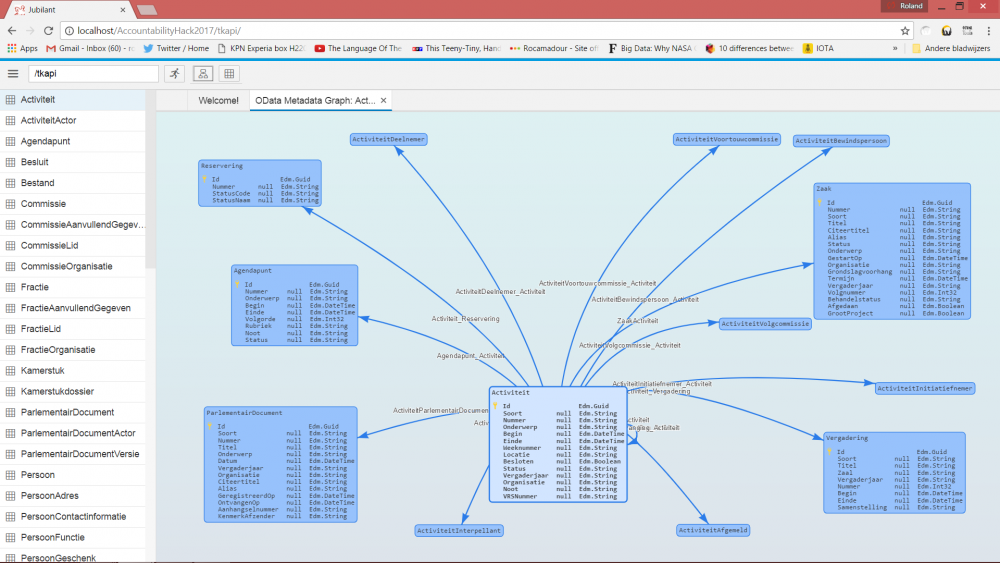
Jubilant is an Open UI5 web application that provides a plugin architecture that makes it easy for developers to write their own data visualisations based on OData services. Jubilant provides rich metadata about OData services, as well as a number of reusable components that make it easy to quickly build a query editor/designer.

The Jubilant concept allows a plugin developer to focus on making a cool visualisation, without having having to invest time and effort to provide the user with a query builder. During the hackathon I managed to create two plugins - one simple table visualisation, which simply renders raw data in a data grid, and a OData Metadata Graph visualiser, which plots the structure, entity types and relationships exposed by the OData service as a graph.

OData and Open Data

The connection to open data and the assignment for the Accountability Hack is that a number of key open data API's use the OData protocol. A good example is the Dutch Parliament API.

Interestingly, there are relatively few OData query tools available, and none of them are particularly affordable. In fact, during the accountability hackathon a few teams tried to work with these OData APIs and discovered they didn't quite know how to access and process them. I don't know if this finding influenced the jury in any way, but it certainly highlighted the need for a tool like Jubilant.

For Just-BI OData is a key protocol as well, since it happens to be the standard way of exposing data by many SAP products, like SAP/HANA. While Just-BI is a general end-to-end Business Intelligence shop, many of our customer engagements have a strong focus on SAP products. This is also reflected in the Open UI5 framework, which has rather good support for OData.

Result: 2nd Prize!

I was surprised, but obviously very happy to have been awarded the 2nd prize, which is good for 1.500 EUR. It is a honour and a privilege to be in a position to work on stuff I like and maybe contribute something to the transparency of the Dutch democracy. And, frankly, I just had a great time hacking!

Since this was basically just a working day for me, I decided to donate 500 EUR of the prize money to Just-Care, which is a charity supported by Just-BI.

Where to get Jubilant?

At Just-BI, we're currently working out the exact details around a release of Jubilant. I will write an update as soon as I can disclose more, but I can already say that all the work I did for the accountability hack will become available as Open Source Software in the very near future.

In the mean while, if you're interested in Jubilant and OData-based self-service BI, don't hesitate to contact me. Or contact Just-BI.

Friday, May 12, 2017

Do we still need to talk about Data Vault 2.0 Hash keys?

A few days ago, I ran into the article "Hash Keys In The Data Vault", published recently (2017-04-28) on the the Scalefree Company blog. Scalefree is a company, founded by Dan Linstedt and Michael Olschminke. Linstedt is the inventor of Data Vault, which is a method to model and implement enterprise data warehouses.

The article focuses on the use of hash-functions in Data Vault data warehousing. To be precise, it explains how Data Vault 2.0 differs from Data Vault 1.0 by using hash-functions rather than sequences to generate surrogate key values for business keys. In addition, hash-functions are suggested as a tool to detect change of non-business key attributes to track how their values change over time.

Abstract

First I will analyze and comment on the Scalefree article and DV 2.0, and explain a number of tenets of DV thinking along the way. Critical comments will be made about using hash values as primary keys in DV 2.0, and the apparent lack of progress made in DV thinking regarding this matter. A discussion follows about the birthday problem and how it relates to DV 2.0 usage of hash functions. Using the Square approximation method it will be demonstrated how we can make informed and accurate decisions about the risk of a collision with regard to the data volume and choice of hash function. Different scenarios regarding the impact of a collision on data integrity will then be explored. Finally, a practical proposal is made to detect hash collisions and to prevent them from introducing data integrity violations into our data warehouse.

A Summary of the Scalefree article

I encourage you to first read the original article. My summary is here below.
  1. The business key is what the business users use to identify a business object.
  2. To identify business objects in the data warehouse, we should use a surrogate key that fits in one column instead of the (possibly composite) business key.
  3. The reason to use a single-column surrogate key is that business keys can be large (many bytes per key field, multiple key fields) which makes them slow - in particular for join operations.
  4. In DV 1.0, sequences are used to generate values for surrogate keys.
  5. Using sequences to generate surrogate key values implies a loading process consisting of at least 2 phases that have to be executed in order.

    The previous point requires some context regarding the architecture of the Data Vault model. Without pretending to completely represent all tenets of DV, I believe the explanation below is fair and complete enough to grasp the point:

    DV stores the data that makes up a business object in 3 types of tables:

    • The business key and its corresponding surrogate key are stored in hub-tables.
    • The change history of descriptive attributes are stored in satellite-tables
    • Relationships between business objects are stored in link-tables.

    So, each distinct type of business object corresponds to one hub-table, and at least one, but possibly multiple satellite-tables. The satellite-tables refer to their respective hub-table via the surrogate key. Likewise, link-tables maintain relationships between multiple business objects by storing a combination of surrogate keys referring to the hub-tables that participate in the relationship.

    This means that for a single new business object, any of its satellite-tables can be loaded no sooner than when it is known which surrogate key value belongs to its business key. Since the new sequence value is drawn when loading the new business key into its designated hub-table, this means that the new business object must be loaded into its hub-table prior to loading its satellite-tables. Likewise, any relationships that the business object may have with other business objects can be loaded into link-tables only after *all* business objects that are related through the link have been loaded into their respective hub-tables.

    In practice this means that in DV 1.0, you'd first have to load all hub-tables, drawing new surrogate key values from the sequences as you encounter new business keys. Only in a subsequent phase would you be able to load the satellite- and link-tables (possibly in parallel), using the business key to look up the previously generated surrogate key stored in the hub-tables.

  6. In DV 2.0, hash-functions are used to generate values for surrogate keys.
  7. When using hash-functions to generate surrogate key values, hub-, satellite- and link-tables can all be loaded in parallel.

    The previous point needs some explanation.

    There is no strict, formal definition of a hash-function. Rather, there are a number of aspects that many hash-functions share and on which DV 2.0 relies:
    • Deterministic: a given set of input values will always yield the same output value. In a DV context, deterministic just means one business key maps to exactly one surrogate key.

      To some extent, a solution based on a sequence as generator of surrogate keys also appears to be deterministic, at least within the confines of one physical system.
    • Stateless: While a solution based on a sequence appears to be deterministic, its values are generated by incrementing the previous value, and by "remembering" the mapping from business key to its corresponding surrogate key by storing them together in the hub. Remembering the mapping by storing it in the hub is what makes it deterministic, because only then do we have the ability to look up the surrogate key based on the business key (and vice versa). But if we'd have two separate but otherwise identical systems, and load the same set of business objects into both, but each in a different order, then the mapping from business key to surrogate key will be different, depending on which object was loaded first in that particular system, because the one loaded earlier will draw a lower sequence number.
    • Fixed output size: DV expects a chosen hash-function to always return a fixed-length value output. (And typically, the length of the hash key should be smaller, ideally, much smaller than its corresponding business key)
    • Uniformity: This means that inputs of the hash-function yields results that are very evenly divided across the output domain. If that is the case, the chance that different inputs (i.e., two different business keys) yield the same output value is very small. The phenomenon where two calls to a hash-function, using different arguments, yield the same result value is called a collision. We will have much to say about collisions later on in this article.

    Basically the idea is that a hash-function can be used to generate a surrogate key value that is typically much smaller (and thus, "faster", in particular for join operations) than its corresponding business key, and it can do so without an actual lookup to the set of existing surrogate key values. Ideally a hash-function calculates its output based soley based on its input, and nothing else.

    It is in this latter aspect that makes it different from a sequence, which generates values that have no relationship at all with the values that make up business key. In the case of a sequence, the relationship between surrogate key and business key is maintained by storing it in the hub, and looking it up from there when it is needed.

  8. When using hash-functions there's a risk of collision. A collision occurs when two different inputs to the hash-function generate identical output.
  9. The risk of collision is very small. In a database with more than one trillion hash-values, the probability that you will get a collision is like the odds of a meteor landing on your data center.
  10. The MD5 hash-function is recommended for DV 2.0. As compared to other popular hash-functions (like MD6, SHA1 etc), MD5 storage requirements are relatively modest (128 bits), while the chance of a hash-collision is 'decently low'. It's also almost ubiquitously available across platforms and databases.

Comments

Many tenets of Data Vault thinking make good sense:
  • The focus on business keys, rather than blindly using the primary key of the source systems feeding into the EDW, ensures that the result will serve the needs of the business.
  • While the use of surrogate keys in transactional systems is still often a source of debate, this practice is not controversial in data warehousing.

    That said, I think the technical reasons for introducing a surrogate key as mentioned by the article (make keys smaller and more wieldy to improve join performance) are not as important as the functional requirement of any data warehouse to integrate data from multiple datasources, and ensuring identity there is resilient to change of the source systems.

  • There's a lot to be said in favor of maintaining attribute history in satellite-tables. In particular, the ability to have multiple satellite-tables is appealing, since it allows you to create and maintain groups of attributes that somehow belong together, and maintain them as a unit. For example, grouping attributes based on their rate of change, or according to whether they tend to appear together in queries sounds like a very useful thing.
  • Link-tables also sound like a good idea. Decoupling direct links from the business objects and maintaining them in completely separate tables makes the EDW very resilient to changes in the data sources. In addition it allows you to add extra relationships that may not be directly present in the source systems but which make sense from the point of view of data integration and/or business intelligence.
  • Once we accept the benefits of satellite- and link-tables and surrogate keys, then we must also embrace hub-tables. The model wouldn't make any sense without it, since we need an integration point anyway to maintain the mapping between business and surrogate key (which would of course be the hub-table).
  • Once we accept the modeling entities of DV, we also need to accept any constraints that surrogate key generation may have on the loading process. Of course, a dependency itself is something we would like to avoid, but the fact that a known limitation is recognized and anticipated is a good thing.

Flashback a few years ago

When I read the Scalefree article, I experienced a bit of a flashback that took me back some two, three years to this question ("Hash Key Collisions") by Charles Choi on the DataVault discussions group on linkedin. In case you cannot access linkedin, I'm reprinting the question below:
According to Dan's paper "DV2.0 and Hash Keys", the chances of having a hash key collision are nearly nonexistent (1/2^128). But I still worry.

What if a collision actually does occur that results in the business making a catastrophic decision? Can we really say we have 100% confidence in the "system of fact" when we choose to accept the risk of a collision? What is our course of action from a technology point of view if a collision did actually occur?
The paper "DV2.0 and Hash Keys" that Charles refers to is publicly available though not freely. (You can purchase it via Amazon.) Here's the relevant statement from the article:
The mathematical chances of a collision as a result of using MD5 are (1 / (2^128)) which is 1 in 340 undecillion 282 decillion 366 nonillion 920 octillion 938 septillion 463 sextillion 463 quintillion 374 quadrillion 607 trillion 431 billion 768 million 211 thousand 456.

In reality, you would have to produce 6 billion new business keys per second per hub for 100 years to reach a 50% chance of getting a collision. Not very likely to happen in our lifetime.
A similar question was asked by Ray OBrien in response to a post by Linstedt (see: #datavault 2.0 hashes versus natural keys):
collisions are real and MD5 not a good choice. but generally the smaller the input key domain and the larger the Hash output size, the less chance of collision, BUT it is always there.. so I would like to see some comments on the verification steps needed and cost to load of Collision ManagementI. If Integrity of data is important, then this is important.
In Linstedt's answer, you can find a similar expression of this probability, which goes:
because we split business keys across multiple hubs, the chances of collision (even with MD5) are next to none.

Yes, they do exist – but you would have to produce 6 billion new business keys Per Second PER HUB in order to reach a 50% chance of a collision in the first place.

Objections

Regardless of the merits of DV (which I believe I stated fairly in the previous section) I have a few doubts and objections on the writing and thinking by DV 2.0 advocates I have observed so far; all around the topic of hash-key collisions. My objections are:
  • The wording around the probability of hash-collisions is not helpful to understand the risk. As such, it does not help to decide whether to use DV 2.0, let alone choose a suitable hash-function for a concrete use-case.
  • The actual numbers regarding probability of hash-collisions are stated flat-out wrong on more than just one occasion.
  • The probability doesn't matter if you can't afford to lose any data
  • DV 2.0 does not discuss the consequences of a hash-collision, and no concrete advice is given on how to detect hash-collisions, let alone handle them.
I believe the questions by Charles Choi and Ray OBrien show that I am not alone. At the time they voiced their doubts, DV 2.0 was relatively new and I can understand that maybe at the time these tenets of DV 2.0 would still need to mature.

A couple of years have passed since, and after reading the article on the scalefree company blog, I am sad to observe that, apparently, no progress has been made in DV 2.0 thinking. At least, if such progress has been made, the scalefree company blog article doesn't seem to offer any new views on the matter. Instead, it comes up with an - equally unhelpful - restatement of the probability of hash-collision by comparing it to the chance of being hit by a meteor.

In the remainder of the article I will explain my objections and attempt to offer some thoughts that may help advance these matters.

The DV 2.0 wording around the probability of hash-collisions is not helpful

First, let's try and analyze the wording around probabilities, and what message it conveys.

Distracting Rhetorics

What does it really mean when someone says that "the probability [...] is like the odds of a meteor landing on your data center"? What does it mean, really, when someone says that the probability is "1 in 340 undecillion 282 decillion 366 nonillion 920 octillion 938 septillion 463 sextillion 463 quintillion 374 quadrillion 607 trillion 431 billion 768 million 211 thousand 456"?

Well obviously, they are saying the chance is very small. Maybe it's just me, but I also sense a level of rhetoric in the wording that seems to be intended to dwarf he reader with Big Serious Numbers.

It's almost as if they're saying: this won't happen, so you shouldn't worry. You're not worrying about meteors hitting your data center all the time, so why worry about a hash-collision? Right?

You can observe that the rhetoric is working too, just look at how Charles Choi voiced his question: "According to Dan (Linstedt) [...] the chances [...] are nearly nonexistent (1/2^128). But I still worry.".

It's as if Charles is apologizing in advance for worrying.

Probabilities are not absolute

There is a more fundamental problem with the probability wording of the previous 2 examples, and that's that they project probability as an absolute.

To be fair, if you read them in context, then you'll notice that both statements are about MD5 collisions. Obviously, this matters, since not all hash-functions have equal probability of collisions. For hash-functions that have a fixed-length output, the chance surely has to have a relationship with the length of the output, since that puts a hard limitation on the number of unique values it could possibly encode.

However, apart from the output length of the hash-function and the algorithm it uses, there is at least one other factor which determines the probability, and that is your data volume.

Intuitively, this is easy to understand: if you have an empty set, the probability of the first hash-value causing a collision is exactly zero, since there is nothing to collide with. At the other extreme end of possibilities, if the set contains as many items as the total number of unique values the hash-function is capable of generating, then the probability of a collision is exactly one, since the entire keyspace has been "used up" already. In between these extremes, we have a growing number of existing entries that could collide with a new entry, so the probability increases from zero to one as the actual number of items (i.e, the number of rows in the hub - the data volume) increases.

While this observation seems trivial, it is important to mention it in this discussion because the aspect of volume is, for some reason, often not touched at all by DV 2.0 advocates. It's a mystery why that should be so, because if we would know the relationship between probability of a collision, maximum possible number of unique values, and the maximum volume of data, then we could reason about these variables sensibly. Like:
  • Given the maximum risk that I am willing to take to lose data due to a collision, what is the maximum volume I can store if I use a 128-bit hash-function?
  • Given the maximum risk of collision that I am willing to take, and given the maximum number of rows I need to store, what would be the mimumum output length of the hash-function I should look for?
  • Given my current data volume, and my current choice of hash-function, what is the risk I am running now of losing data due to collision?

The Birthday Problem

Interestingly, Linstedt does provide one statement that at least takes the data volume into account: "you'd have to produce 6 billion new business keys Per Second PER HUB in order to reach a 50% chance of a collision in the first place". Let's see what that means exactly.

Apart from the probability, this statement includes the other two variables: 128 bits keylength of MD5; a data volume of 6 bio rows per second for a 100 years. But if you look at the probability (50%) you'll notice how completely useless this wording is, that is, apart from its rhetorical power. Who in their right mind is interested in a system that can only accept half of the data you're trying to store in it? How can you possibly apply this piece of knowledge in any practical sense to a system you have to actually build?

I spend a while thinking about how this statement could have come about, and I have to come to believe that it is actually a restatement of the classical birthday paradox:
The birthday paradox, also known as the birthday problem, states that in a random gathering of 23 people, there is a 50% chance that two people will have the same birthday.
(As compared to Linstedt's statement, the 50% probability stays the same; the 6 billion rows per second for a 100 years is equivalent to the number of people gathered, and the number of possible unique values in the key corresponds to the number of days in a year.)

Whether or not the original birthday problem statement is actually what made Linstedt's word his statement like he did, I think it's clear that a 50% probability of a collision has no practical bearing on building any kind of database. To me, it just sounds like more rhetoric to convince that hash-collisions are really rare.

Probabilities are stated flat out wrong

The discussion of the birthday problem brings us to an actual method to calculate the probability as a function of data volume and key length. The wikipedia article I linked to provides an exact method, as well as many useful approximations, which are much easier to calculate. The birthday problem wikipedia article explains it far better than I ever could do, and also provides this really useful rule-of-the-thumb called the square approximation:
A good rule of thumb which can be used for mental calculation is the relation

p(n) ≈n2
/
2m

which can also be written as

n ≈ (2m * p(n))

which works well for probabilities less than or equal to 0.5
with
n
the actual size of the keyset - i.e, the number of rows you need to fit into the hub
p(n)
the probability of a collision given n.
m
the theoretical maximum size of the keyset, i.e. the maximum number of unique values that your hash-function can encode.
Given a fixed length hash-function, such as MD5, then m can be calculated by raising it to the power of the keylength (expressed as the number of bits):


m = 2 ^ bitlength (or 2bitlength)

(In case this needs explaining: if your key would be just one bit long, then it can old only two values - 0 or 1 or 21. If the key would be 2 bits long, it could hold 2 * 2, or 22 = 4 unique values. With 3 bits, 2 * 2 * 2 or 23 = 8 and so on)

From the discussion above as well as the previous section, we can now conclude that at least one statement of the probability:
The mathematical chances of a collision as a result of using MD5 are (1 / (2^128))
is simply flat-out wrong, since it does not take the data volume into account. Rather, since 2^128 is the number of possible unique values that MD5 can cover, 1 / 2 ^ 128 is the chance that the second row you put into your hub will collide with the first one.

So how big or small are the odds really of running into a MD5 collision in case we're handling a volume of 6 billion rows per second for a 100 years? Using square approximation, we get:

p(n) ≈(6,000,000,000 rows * 60 seconds * 60 minutes * 24 hours * 365.25 days * 100 years)2 ≈ 0.526
/
2 * (2 ^ 128 bits in a MD5 hash-value)


which is in fact closer to 53%. To figure out how many years we would need to insert 6 billion rows per second to achieve the 50% chance of running into a collision, we can use the second form of the formula:

n ≈ (2 * (2 ^ 128 bits in MD5 hash-value) * 50% probability) ≈ 1.84467e+19 rows in the hub

Dividing by 6,000,000,000 rows * 60 seconds * 60 minutes * 24 hours * 365.25 days will give you 97 and slightly less than a half year.

The point of doing these calculations here is obviously not to prove Linstedt wrong by showing you'd already arrive at a 50% after only 97 years and some instead of after a 100. Nor is it to determine that after 100 years, the chance is actually closer to 53%. Besides the fact that I'm using an approximation, neither makes any sense anyway, because the probability of 50% is already way, way beyond any definition of a working system.

The point I am trying to make is that it is perfectly possible to reason about large numbers and to clearly and transparently demonstrate how they are calculated. Using square approximation, you have a tool to calculate the value of the third variable once you have the value of the other two, allowing you to reason about it from three different angles.

I think we can all agree that's a much better position than getting stumped by Really Seriously Big Numbers.

Probabilities add up for each keyset

So far, we've just looked at the probability for encountering a collision while loading a single hub. But the probability increases as you have more hubs.

Intuitively this is clear because each hubs could encounter a collision independently. So, the chance of suffering a collision in either one of them grows as you have more hubs to maintain, and is quite a bit more than the chance of suffering a collision in just one particular hub.

If we'd like to compute the chance of getting a collision in at least one hub we can apply the following calculation:
1 - ((1 - Ph1) * (1 - Ph2) * ... * (1 - PhN))
with:
Ph1
Probability of a collision in the first hub
Ph2
Probability of a collision in the second hub
...
PhX
Probability of a collision in the last hub
The rationale behind this is that if the probibility of a collision is P(n), then the chance of not having a collision is 1 - P(n). To calculate the chance of not having a collision in any of the hubs, we have to multiply the individual chances of not having a collision in one particular hub with each other. If that number is the chance of not having a collision in any of the hubs, then all remaining probability must mean there is a collision in one or more hubs. So the chance of having at least one collision is obtained by substracting the probability from having no collision at all from 1.

So the chance that someone ever will encounter a collision could be quite a bit larger than you'd expect if you're focussing on just one hub.

No matter how slight a Probability, I can't afford to lose data

Now we arrive at a more fundamental objection regarding the matter of using hash-values as keys in your database.

If you re-read Charles question, you'd notice that he is politely explaining that, although he understands and appreciates that a MD5 hash-collision maybe really rare, he simply doesn't ever want to lose any data because of it. Ray OBrien raises the exact same point, even mentioning data integrity as the reason why he cares.

When this issue is put forward in DV 2.0 disucssions, it usually means the end of any meaningful discussion. The answers that DV 2.0 advocates usually give in response typically match one of the following:

"Look, do you realize how rare a hash-collision is?"
Yes thank you. You just stumped me with some Really Seriously Big Numbers, and I get it. Super rare. I just don't want to lose data though.
"You don't have to use 128-bits MD5, you can use a hash-function that returns larger values, like 160-bits SHA1. Collisions will then be, you know, even more rare."
Perfect thanks. Did I mention I can't afford to lose data?
"We use 2 hash-functions as key and it works for us."
Ah, I get it now. You made collisions Super-duper-rare, how clever. So will you never lose data now?
"I have built hundreds of Terabyte-sized data warehouses, and I never encountered a hash-collision."
Well let me guess. Might that be because they are very rare?
"Teradata is using hashing to solve MPP data distribution, and Hadoop uses hashing in HDFS. If it works for them, then why wouldn't it work in DV 2.0"
So you're saying Teradata and Hadoop use hashing for some purpose, and DV2.0 is using hashing for a completely different purpose, and now you want me to explain why it works in one use-case but not for a completely different use-case? That's...interesting.

How about: Teradata and Hadoop are not using hash values as primary keys, and DV 2.0 is?
"Look, why are you so worried about hash-collisions? You're not worrying all the time about a meteor hitting your data center, are you?"
Actually, I do. That's why our database is geographically distributed across data centers.
"Ha! Gotcha now. What about two meteors? Wouldn't that be comparable to using two hashes?"
I suppose it would. Difference is, I can't help meteors falling on my data centers. But I can choose to stick to sequences instead of hash-functions.
"But I just explained, sequences are a bottleneck and prevent you from parallel loading your EDW!"
Yes I heard. And I asked my customer: they are pretty sure about how they feel regarding the possibility of losing data, and they clearly told me they'd rather wait around for the data to be loaded as compared to being able to report super-quickly on wrong data.
"We use hash-keys to store tweets for sentiment analysis, and our results are pretty accurate, even if we lose data sometimes."
I'm sure you are- good for you! But we manage a monetary transaction log and we feel that the risk of losing one $1,000,000,000 transaction just doesn't justify loading 1,000,000,000 transactions worth $1 super-fast in a parallel fashion. Silly us eh?


And that's really all there is to it: Probabilities don't mean a thing if you're really sure you don't want to lose any data. When it happens, it is no comfort that you were the one to have had such extraordinarily bad luck experiencing it.

Another thing people may overlook is that the probability also doesn't tell you when it will happen. The only real guarantee you have is that inserting the first key in an empty hub will always succeed. But already the 2nd row might collide. It probably won't, and the odds are really slim. But it might. If you're sure you don't want that, then don't use hash values as keys. It's really that simple.

Sure, there might be other risks that could make us lose data. For example, the probability of disk corruption might be larger than that of a hash-collision. But it doesn't follow that we should be setting ourselves a trap if we can avoid it, especially if you know how to avoid it.

We cannot control disaster like disk corruption or meteor impact. If we could though, we would! Whether to use hash keys or to stick to sequences is a conscious choice, so let's be sure we make it based on information and requirements, and rather not based on some analogy that is chosen with the express purpose of making you feel a little bit ridiculous for being so averse to taking a risk.

If you're building a database for someone else, and you're considering to use hashes as keys for your data, then be prepared to ask you customer: "How many data can you afford to lose?" or "In the event that we cannot load some data due to hash-collisions, how much time and effort can we spend to take it offline so we can fix it?"

Another way to think about it is this: Suppose you would, in fact, lose data because of a collision. Then how comfortable are you to admit to your customer that you constructed a solution, that, by design, could end up giving you wrong results, while there was an alternative that guarantees correctness, at least to the extent of things you can control? And suppose you would get wrong results, did you anticipate just how wrong those results could be?

I truly feel that considerations like this are not on the database/data warehousing professional - they are on the customer. It's their data. Please, respect that.

What if we do have a collision?

I get that there are use cases where you might want to accept the small risk of a collision. But you cannot really, truly make that assessment if you haven't considered and anticipated it as if it is a real event actually hitting you. I think DV 2.0 falls short in nourishing healthy discussion regarding the anticipation of such events.

So, what will happen if you have your hash-keys in place, and you encounter a collision? We can try and anticipate a few concrete scenarios.

First of all, will you even detect a collision when it happens? The Scalefree article has a few flow diagrams showing how raw data is staged, and then loaded into a hub. In that flow, the row is dropped when the hash already exists. So the question now is, why did the hash already exist?

Obviously, it's possible that we already loaded this business object, and we're merely seeing it again. In that case, we're fine and we'll simply be loading newer data into the satellites and links for that business object. But it's also possible that this is an entirely different business object that happened to yield the exact same hash-value as that of a different business object loaded earlier. In other words, you now have a collision. For the hub, it will pass by unnoticed, but the satellites and links that point to that business object will now store data pertaining to more than one distinct business objects.

So in this case, we're not losing data, but compromising the integrity of the business object that arrived earlier. Our database integrity is now violated and our queries will return wrong results. You won't know though, because you didn't attempt to detect a collision. To your data vault, the distinction between multiple different business objects has ceased to exist.

I don't know about you but this does not feel like a happy place to me - especially if this an inevitable and avoidable consequence of the design. (And a whole bunch of bad luck of course).

Alternatively, we build our solution in such a way that we can at least detect collisions. Once we detect it, we can maybe prevent loading associated data for the satellite-tables and link-tables for the colliding business object. This means we will be completely ignoring the later arriving business object, as if it isn't there.

We have now lost data. That is not a good thing, but at least this allows the earlier arriving business object to maintain its integrity. Our query results won't be wrong, they will just be incomplete. To me this is a slightly happier place, but the fact that it's a matter of fate which one of the objects made it into the database, and which one was rejected still makes me feel that the solution has failed.

But suppose we do want to go for that treatment (after of course getting confirmation from the business that this is really what they want) - how can we implement it? Well, at the very least, the load process for either the hub or the staging area would need to compare the hash value as well as the business key. Only if both are equal can we consider the objects equal.

Making the comparison is not hard but it will of course be slower than only calculating the hash, because in this case you need a lookup on the hub, just like you did with the DV 1.0 solution based on sequences.

But what if we detect the collision in this way? How can we then use this information to prevent loading the associated satellite- and link-table data?

Introducing a collision table

We could store collisions in a special collision table. We'd get one such table for each hub. The collision table would have the same layout as the hub table to which it corresponds, and you'd use it to store the colliding hash, as well as the business key for which the collision was met. The key of the collision table would have to be made up of both the hash key as well as the business key, so that we can handle multiple collisions for the same hash key.

Once the collision table is in place, and the process for loading the hub-tables is modified to detect and store collisions, we can think about the process for loading the satellite- and link-tables. I can see two options
  • Have the load process for satellite- and link-tables do a lookup to the collision table to see if you need to discard data for business objects with collisions
  • Check collision tables after the load and run a clean-up process to restore integrity after detecting new collisions.

Collision table lookup

This solution relies on the process that loads the satellite- and link-tables to make a lookup to the collision table, using both the calculated hash and the business key. If collisions really are as rare as they should be, then that lookup should be really fast, because the collision tables will be pretty much empty.

If all goes well, then the lookup will fail. This means we have no collision and we can proceed loading the satellite- and link-tables. In the rare event that the lookup succeeds there is apparently a hash-collision, and we must not load the satellite- and link-tables to prevent violating the integrity of our data. You are now in a position to either discard the data, or to store it someplace else in case you have a clever idea of reconciling the data later on.

However, we now have reintroduced the constraint on the loading process, because we now rely on the process that loads the hubs to also detect and store collisions in the collision table.

So, with this solution, we lose the ability to load hub-tables in parallel with satellite- and link-tables. What may be of some comfort in comparison with the DV 1.0 sequence based solution is that the collision table lookup will be much faster than a hub-lookup to find the value generated by a sequence, because the collision table will be pretty much empty. So, the burden of the constraint and loading dependency should be much lighter than in the case of a DV 1.0 sequence based solution.

Another important drawback is that if your solution spans multiple systems, you need to maintain one set of collision tables somewhere, and all loading processes will be dependent upon them. In other words, the solution is not stateless anymore.

Clean-up after load in case of new collissions

Alternatively, we keep loading hub-, satellite- and link-tables in parallel, and we check the collision tables after each load to see if the last load introduced any new collisions. If we find that it did, we need to perform clean-up after the load.

The way clean-up would work is as follows: our load process should have been logged and our satellite- and link-tables should have metadata identifying the load process that put its contents in the data warehouse. The load identifier would also be stored in the collision table. Using that information, we can identify which new collision our last load introduced. We now have the load identifier as well as the hash key of the new collision, and we can then use that to delete all satellite- and link-table rows that have the load identifier of our latest load, as well as the hash key of the colliding business object.

After clean-up, we have restored data integrity for those business objects that encountered a collision, up to the point prior to the last load.

Now, we know that our last load brought us a business object that had a hash collision with some business object that was already in our data warehouse, and we made the conscious decision to reject that data for now, or maybe store it somplace else untill we know how to reconcile it. But the last load might also have brought us data that actually belonged to the business object that already existed in our data warehouse. We would really like to reload that part of the data for the existing business object. Our clean-up process had no way of distinguishing between satellite- and link- data for the one or the other business object, because it only knows about their colliding hash keys. In other words, our clean-up process might have removed data that actually did belong to the already existing business object, and now we need to put that back.

The solution would be to have an alternative load process especially for this -hopefully exceptional- case.

The alternative load process would be similar to the collision table lookup solution described above. It would only load satellite- and link-tables, and it would include a lookup to the collision table. If the lookup fails, we're dealing with data belonging to the existing business object and we can load it. If the lookup succeeds then this is data that belongs to a new business object that caused a collision and we should discard it or store someplace else for later reconciliation.

If things go the way they should, then the clean-up-and-reload process should occur seldom. And if we need to run it, it would probably be quite fast since it deals with only a few business objects - typically only one.

The only drawback now is that our data warehouse lived through a short period where integrity was compromised during the load process. But at least, we can repair integrity for all existing business objects, and selectively discard only data for those business objects that suffer from hash collion with an already existing business object.

While this approach still relies on keeping collision tables around, we regain our ability to load hub-, satellite- and link-tables in parallel. We can even do loads spanning multiple systems; we just need to take care to clean those up as well in the case we do encounter a collision.

Other solutions?

I don't want't to pretend this is an exhaustive list - I'm hoping there are more options and I just can't think of them right now.

How to load the colliding business objects?

What these scenario's do not solve is loading the later arriving business object. We only managed to prevent these objects from entering our data warehouse, but have not found a solution to load that data as well.

And, We can't - not unless we change the key.

On the other hand, changing the key might just be doable: you could decide to try another hash-function for at least that hub. You would need to update all satellites and links pointing to that hub (and of course, the hub itself) and rehash every row that points to it.

Of course, since you're still relying on hash-keys, just - hopefully - larger ones, you haven't solved the problem, you've just increased the odds. And you might even run into new collision while you're doing the rehashing operation. But that's just the life you've chosen. At least we now have something that resembles dealing with the problem rather than praying it won't happen.

I guess my main point here is - make sure every stakeholder is actually accepting the risk and make sure the procedures for dealing with a collision are specified and tested. The fact that the chance you'll need it may be next to neligible is not a license to pretend you do not need to be prepared to do these tasks. If it is decided that you'll be taking the risk, then actually do take the risk, and take it seriously.

Can't we have our cake and eat it too?

Isn't there some way we can benefit from hashes and still, magically immunize ourselves against hash-collisions? It turns out we can.

To recap:
  • DV, like other data warehousing methods - suggests using surrogate keys, because business keys are largish and unwieldy, and slow down join operations.
  • DV 2.0 suggests using hash-keys to avoid sequences, which make it impossible to load hubs, satellites and links all in parallel, and which slow down the load due to a lookup in a large hub.
This maybe a longshot, but it has as advantage the guarantee that it will work. As should be amply clear from the discussions in this article, hash-keys always have the chance of a collision, and it doesn't matter how small the risk is if you already know you do not want to accept losing data or giving up integrity. So, what is clear is that if that is the requirement, you cannot use hashes as keys. Period.

But that does not mean we cannot benefit from hashes.

Especially if the hash-key is small in comparison with the business key, then we could build up our keys as a composite of the hash-code, followed by the field or fields that make up the business key. If our database uses B-tree indexing, then any joins will be able to resolve the join in the very vast majority of cases only based on the hash-key column, which should be the first column in the key definition. You would still keep using the fields of the business key in your join conditions, to ensure that, in case of a hash-collision, the query will still return the correct result. Since the collisions are so rare, the database will end up with very few rows after it has resolved the join over the first field in the key, so the overhead of such a large key should be minimal.

Of course, this solution does not help in cutting down the amount of data you need to store - that will be much more in this scenario since you keep dragging the business keys literally everywhere: every satellite and every link table that points to this hub will inherit the column for the hash, as well as all columns that make up the business key. But if it helps - it should just add to the storage requirements, and not that much in terms of join processing.

The benefits of the -relatively- fast join will break down though when the database already uses hash-joins. In those cases, it will not be able to use the first column of the keys as prefix.

Finally

I hope you enjoyed this article. I am super curious to hear from DV practitioners if they have scenarios we can learn from. Drop a line in the comments! I'm looking forward to it.

DataZen winter meetup 2025

The DataZen winter meetup 2025 is nigh! Join us 18 - 20 February 2025 for 3 days of expert-led sessions on AI, LLM, ChatGPT, Big Data, M...